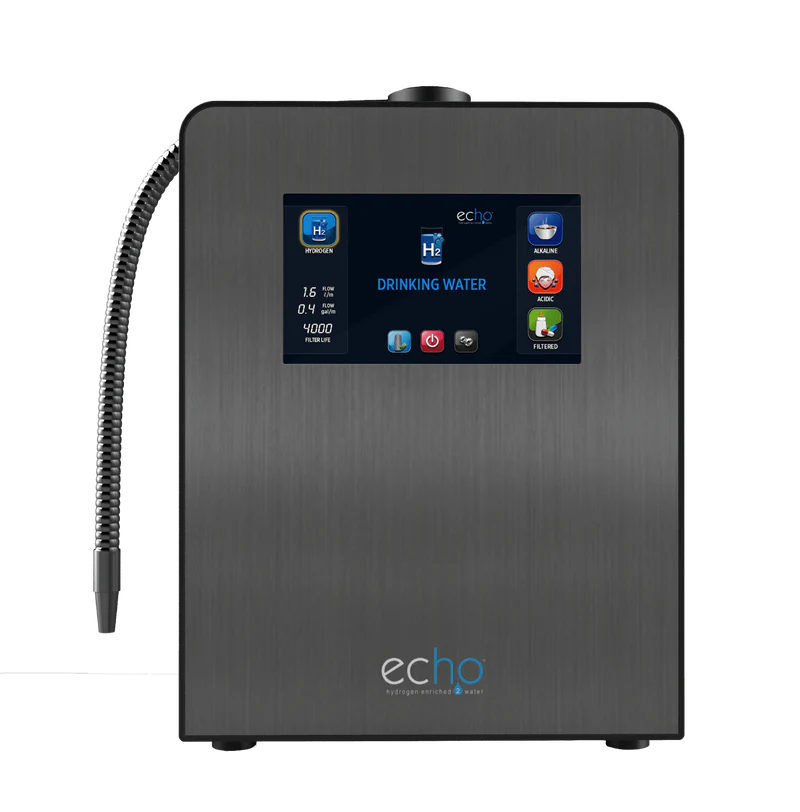
When you look at an Echo H2 machine, the first thing you notice is the “flowers.” Let’s be honest: Synergy Science makes some of the best-looking water hardware on the market. Their brushed-steel and chrome aesthetics are a welcome relief from the bulky white plastic look of legacy brands (we’re looking at you, Enagic).
Echo machines look like they belong in a 2026 high-end kitchen. But as a technical research site, we have to look past the “skin” and into the electrolysis chamber.
The Big Disclaimer: It’s Not a Water Ionizer
If you’re looking for a machine that shifts your water’s pH (alkaline or acidic), the Echo H2 is not for you.
Traditional water ionizers use electrolysis to separate water into alkaline and acidic streams. Echo machines, however, are specifically Molecular Hydrogen Generators. They are designed to infuse H2 gas into your water without altering the pH level.
While this is great for people who want the benefits of hydrogen without the potential stomach-acid-buffering effects of high-pH water, it means you can’t produce the “Strong” 11.5 pH cleaners or the 2.5 pH disinfectants that a real ionizer can.
The “Dirty Water” Trap
This is the most critical point for any potential Echo buyer: Molecular hydrogen is only as good as the water it’s in.
Hydrogen water machines are essentially “finishers.” They take your water and add a functional gas (H2) to it. However, if your tap water contains Lead, Chromium-6, PFAS, or Fluoride, an H2 machine doesn’t transform that into “healthy” water. It just gives you “Hydrogen-Enriched Toxic Water.”
Most Echo models rely on a single internal filter. While it’s better than nothing, it lacks the multi-stage, dual-filtration power of a technical powerhouse like AlkaViva or Tyent. Before you invest $2,500+ in an H2 machine, you need to ensure your water is actually clean.
The “Dog” Report: Filters and Reliability
Now for the “dogging.” While the machines look great, the ownership experience can be a bit of a mixed bag:
- The Filter Tax: Expect to pay a premium to keep your water clean. Echo’s single replacement filters are often priced around $110 each. For a single-stage filter, that is one of the highest maintenance costs in the industry.
- The Warranty Gap: While top-tier competitors offer full Lifetime Warranties (parts and labor), Echo typically offers a 5-year warranty. In this price bracket ($2,000 - $3,000), a 5-year guarantee feels a bit lackluster.
- Reliability Concerns: Our user feedback suggests that while Echo support is generally good, the machines themselves can be temperamental regarding water pressure and scaling. Because they don’t shift pH, they don’t “feel” like they’re working, making it harder for the average user to tell when the plates are scaling up.
The Verdict
If you have pre-filtered, high-quality water and you exclusively want the benefits of molecular hydrogen without the alkaline pH shift, an Echo machine is a beautiful, high-status choice for your kitchen.
However, if you are looking for a comprehensive water solution that provides elite-level filtration (Lead/PFAS/Fluoride removal) and the flexibility of pH-shifting technology, a true water ionizer is still the superior choice for 2026.
Curious how Echo compares to the rest of the 2026 market? Check out our 2026 Comparison Table or read our deep-dive on Ionization vs. Filtration.